Getting rejected repeatedly can make you question everything.
Getting rejected repeatedly can make you question everything
Your experience. Your qualifications. Your resume. Even your career direction.
But there is another possibility worth understanding. The hiring system itself may be influencing how your application is evaluated.
A 2026 study titled Algorithmic Monocultures in Hiring examined around 3 million applicants and 4 million applications. The researchers found that some candidates received repeated recommendations for rejection across multiple applications, at rates higher than would be expected if each decision were completely independent.
They call this phenomenon algorithmic monoculture.
The important point is not that algorithms are automatically bad. It is that similar hiring technologies can sometimes produce similar outcomes.
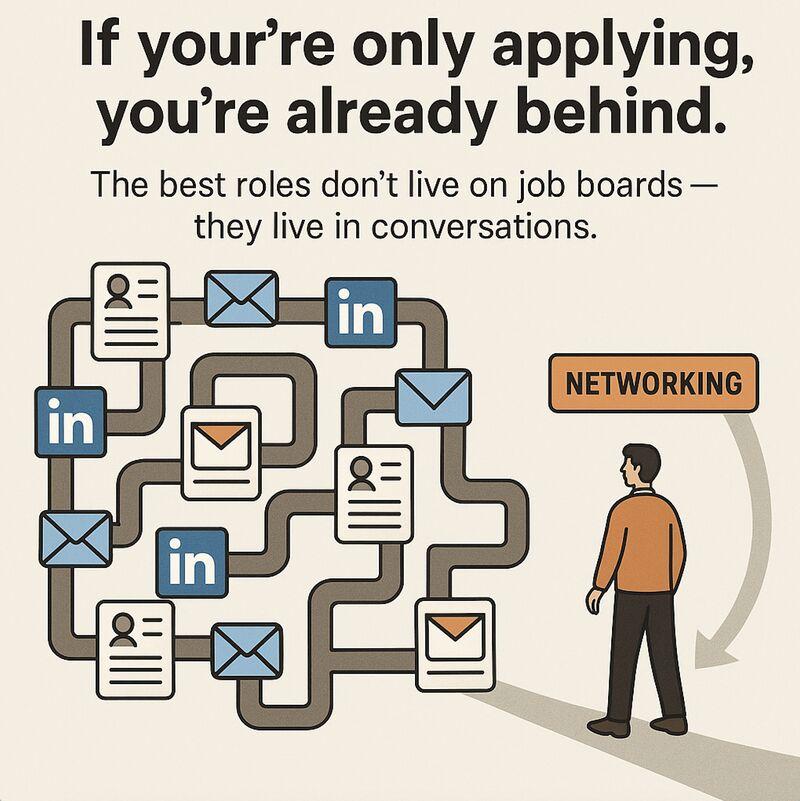
So if your entire job search looks like this: find job, submit resume, wait, rejection, find another job, submit resume again, you are repeatedly entering through the same type of door.
And this is where LinkedIn becomes interesting.
LinkedIn can be the roundabout
Imagine a busy road where every candidate is trying to enter through the same gate. The application process is one entrance. But LinkedIn gives you another route.
Not a way to trick the algorithm. Not a guarantee of getting hired. A different path to becoming visible.
Your resume primarily answers: “Should this application move forward?”
Your LinkedIn presence can help answer a different question: “Who is this professional, and what do they actually do?”
That distinction matters.
1. Move from applying to positioning
Before you start networking on LinkedIn, get clear about what you want to be discovered for.
Instead of “I am open to anything,” choose two to four realistic target roles. Then make your headline, About section, Experience section, and Skills section support that direction.
You want someone visiting your profile to understand quickly: what do you do, what are you good at, what problems can you solve, what roles are you targeting. That is positioning.
2. Make your profile searchable
Recruiters use LinkedIn to search for professionals. That means your profile should contain the language associated with your target roles: your job titles, your core skills, your industry, relevant tools, areas of expertise, types of work you have done.
But keywords alone are not enough. Your profile should also provide context and evidence.
Instead of simply saying “Managed production operations,” show what you managed, the scale involved, the problems you handled, and the outcomes you contributed to.
The objective is not to stuff your profile with keywords. It is to make your professional value understandable.
3. Let people discover your expertise
This is where LinkedIn becomes more than a profile. You can publish, comment, share observations, discuss industry developments, explain something you know well, show a project, talk about a problem you solved.
You are creating evidence of your expertise before someone asks you for your resume.
A recruiter who discovers your profile can see more than a list of responsibilities. They can see how you think. That is a fundamentally different kind of visibility.
4. Build relationships before you need them
This is perhaps the biggest opportunity.
LinkedIn’s recent research on networking in India found that Indian job applicants with an inside connection at a company were nearly 8.5 times more likely to be hired than applicants without one. LinkedIn defines an inside connection as having a first degree connection working at the company. Importantly, this is an association, not proof that the connection caused the hire or that the person made a referral.
The implication is not “collect as many connections as possible.” It is: build professional familiarity.
Follow people whose work interests you. Read what they post. Leave thoughtful comments. Ask relevant questions. Connect when there is a genuine reason. Start conversations before you need a favour.
That turns LinkedIn from a digital resume into a professional relationship platform.
5. Apply and network together
This is the part many job seekers miss. You do not have to choose between applying and networking. You can do both.
Find a relevant position. Apply if it genuinely fits. Then look at the company. Who works there? Who leads the function? Who recruits for that area? Who has a similar professional background?
You may discover someone who can help you understand the company, the role, or the industry. The application becomes one part of your strategy rather than the entire strategy.
The goal is not to beat the algorithm
There is an important distinction here. LinkedIn itself is also an algorithmic platform. So this is not a way to escape algorithms. It is better understood as another visibility layer.
The algorithm may evaluate your application. But your LinkedIn profile can help people discover you. Your content can demonstrate your expertise. Your network can create professional familiarity. Your conversations can create access to information and opportunities.
That gives you multiple pathways instead of depending entirely on one.
The modern job search is no longer simply apply, wait, hope. It can become: position, become discoverable, build relationships, demonstrate expertise, apply strategically.
That is why LinkedIn works as a roundabout in an increasingly algorithmic hiring market. You are not trying to cheat the system. You are simply creating another road to the same destination.
And sometimes, when one route keeps taking you to the same result, the most useful question is not “how many more times should I try this route.” It is “what other route can I build?”
Sources: Bommasani, Bana, Creel, Jurafsky & Liang, “Algorithmic Monocultures in Hiring,” 2026 (arXiv). LinkedIn Research, Network Lift analysis based on 5 million LinkedIn members and job applications, 2026.
If you want your LinkedIn profile built for this kind of visibility, keyword-searchable, positioned around the roles you actually want, and structured to hold up when a recruiter looks past your resume, take a look at our LinkedIn Profile Optimisation service.
Not sure whether your current profile is doing this job for you? Send us a message and we will give you an honest read on where it stands.